Editor's note: this essay is my personal view as editor of Singularity Review. It is not investment advice. I am not recommending that anyone buy or sell any security. Markets can fall sharply and stay down for years; if you are making decisions with real money, talk to a qualified, independent adviser.
The forecast of an AI crash has moved from the fringe to the official record. On 30 September the Bank of England's Financial Policy Committee wrote that "the risk of a sharper correction persists," especially if worries about "the pace of AI development or adoption" hit earnings expectations. Governor Andrew Bailey put it more plainly to the BBC a day later: "Everybody is currently priced to be a winner... not everybody is a winner." On 13 October the International Monetary Fund warned that "the consequences of an AI correction could be global."
Investors and strategists have started putting dates on it. Ray Dalio told a Forbes conference in Singapore on 7 October that AI is a "classic bubble" and that "we're close to" the point where it bursts. A day later Joachim Klement of Panmure Liberum told Bloomberg: "My core conviction is that the AI bubble will either burst in 2027 or in 2028." His year-end 2027 target for the S&P 500 is 5,000, about 36% below current levels. In May, fund manager Dan Niles said AI-linked stocks "probably go down 30% to 50%" in early 2027.
This week offered a warning tremor. Twenty of the largest AI and chip stocks lost more than $1 trillion in value, and the chip index fell 11.6% in six sessions. Yet by Thursday the S&P 500 was only about 1% below its record. So the real question is not whether a crash is happening now, but whether one is coming. Here is the strongest case on each side, followed by what I think matters more over the long run: what AI is actually doing in the economy.
The case for a crash in 2026 or 2027
1. The market leans on a handful of AI names. The "Magnificent Seven" (Alphabet, Amazon, Apple, Meta, Microsoft, Nvidia and Tesla) make up more than 35% of the S&P 500, against 12% a decade ago, the IMF says. Fund manager Jason Teh calculates that ten AI leaders account for 42% of US stock market value, above the 41% that technology, media and telecom stocks reached in 2000. When so much rests on so few, one bad quarter can move everyone's pension.
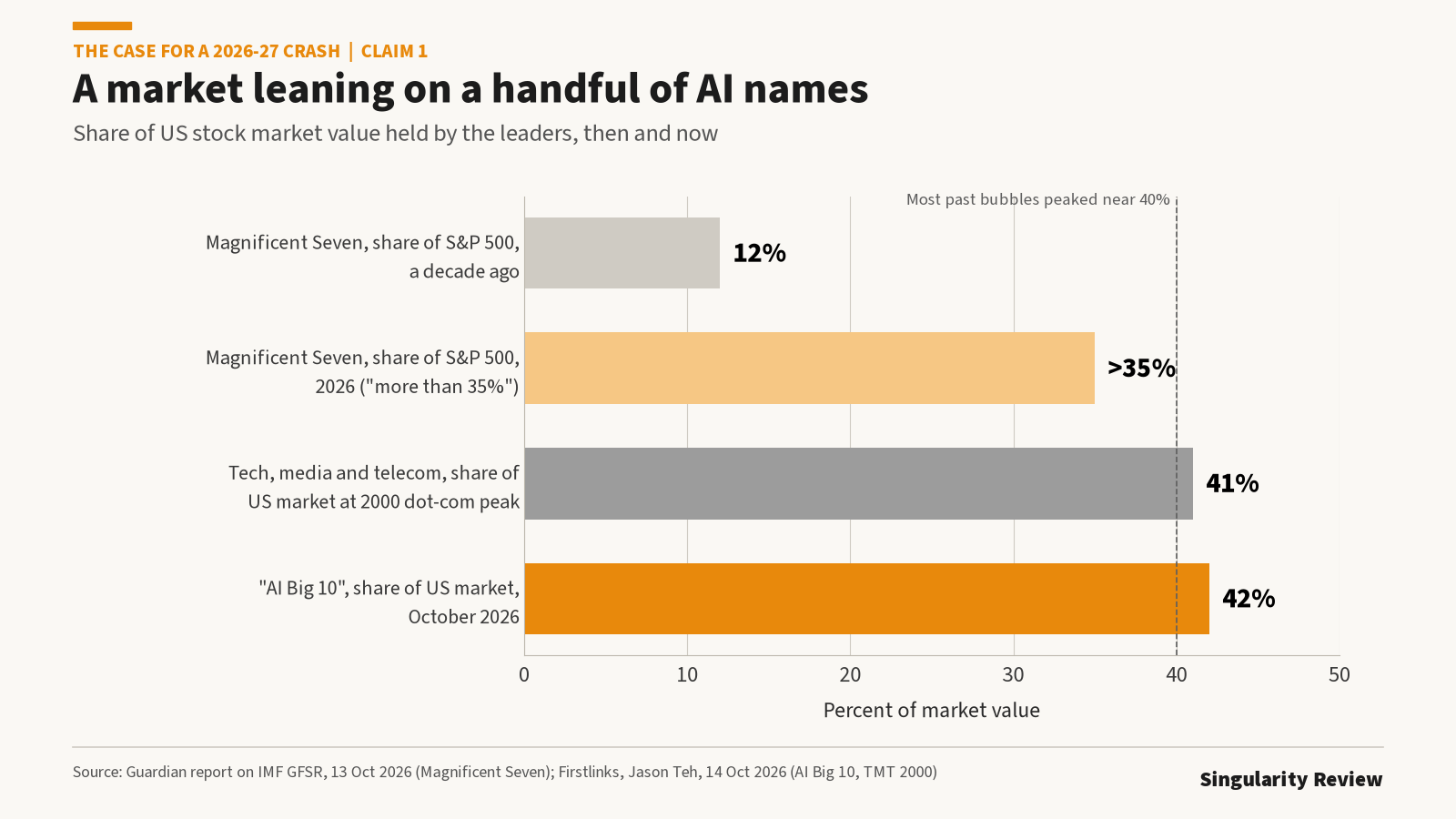 Most past bubbles peaked when the leaders held about 40% of the market.
2. Spending is outrunning both cash and revenue. Microsoft, Alphabet, Amazon and Meta spent $165.1 billion on capital projects (capex, money for long-lived assets such as data centres and chips) in the second quarter of 2026. That swallowed 96% of the cash their operations generated, up from 49% two years earlier, according to BlockWest Research's tally of their filings. Amazon and Alphabet spent more than they took in. Looking further out, Bain & Company estimated that AI data centres will need $2 trillion of annual revenue by 2030 to justify the build-out, and that the industry could still fall $800 billion short.
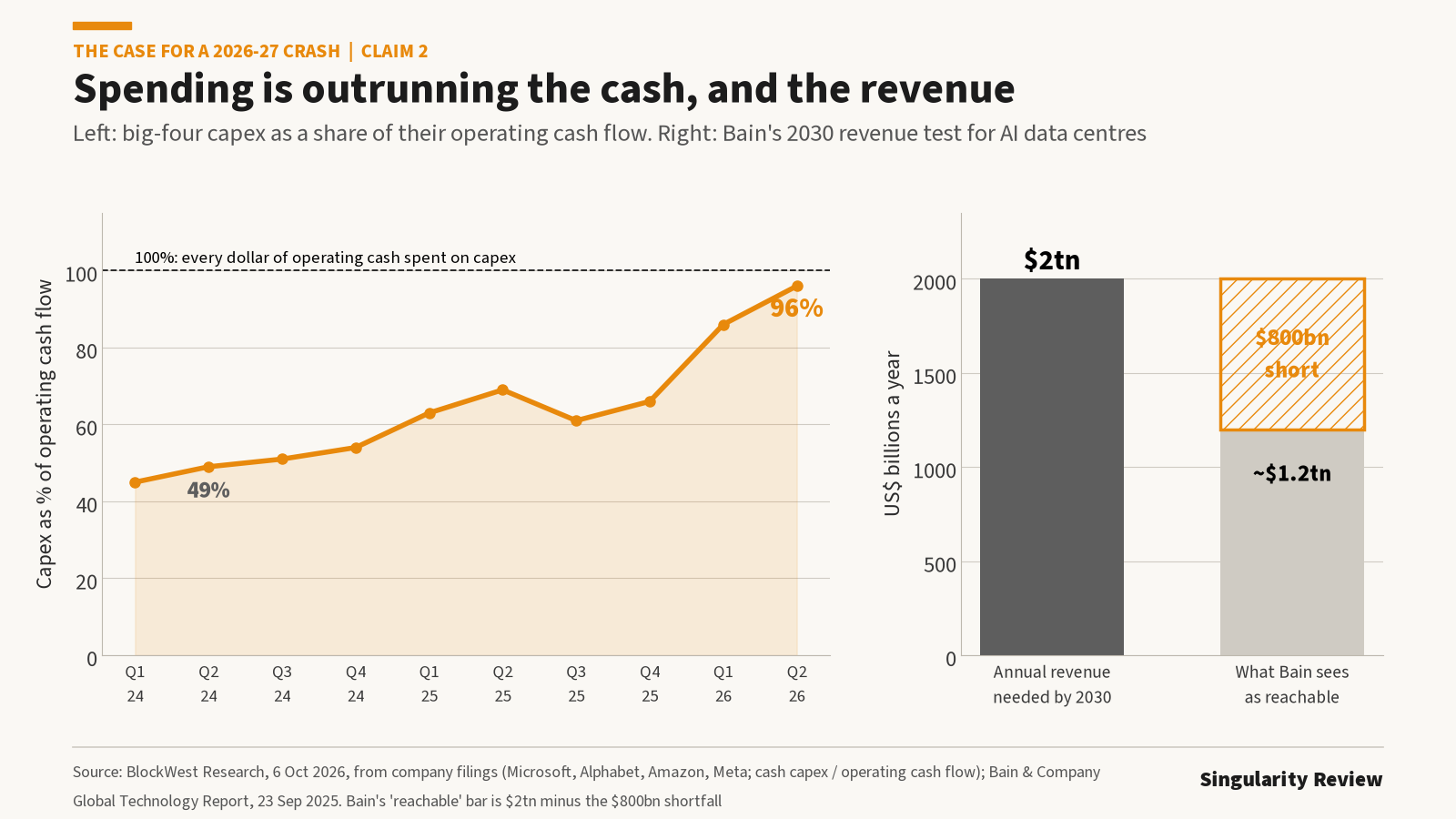 Bain's figures are a 2025 projection, not a measurement.
3. The bills for borrowed money start arriving. Morgan Stanley counted about $450 billion of AI-related debt issued globally by early September, more than double all of 2025, the Bank of England noted. The research firm Atrium has mapped about $1.3 trillion of US data centre debt: $128 billion of it matures between 2025 and the end of 2027, mostly borrowed when short-term rates were between 0.05% and 4.5%. Refinancing now costs above 6%. CoreWeave, the most indebted AI cloud provider, must repay $4.4 billion of principal in the rest of 2026 and $6.2 billion in 2027, according to its own filing, and its quarterly interest bill has more than doubled in a year.
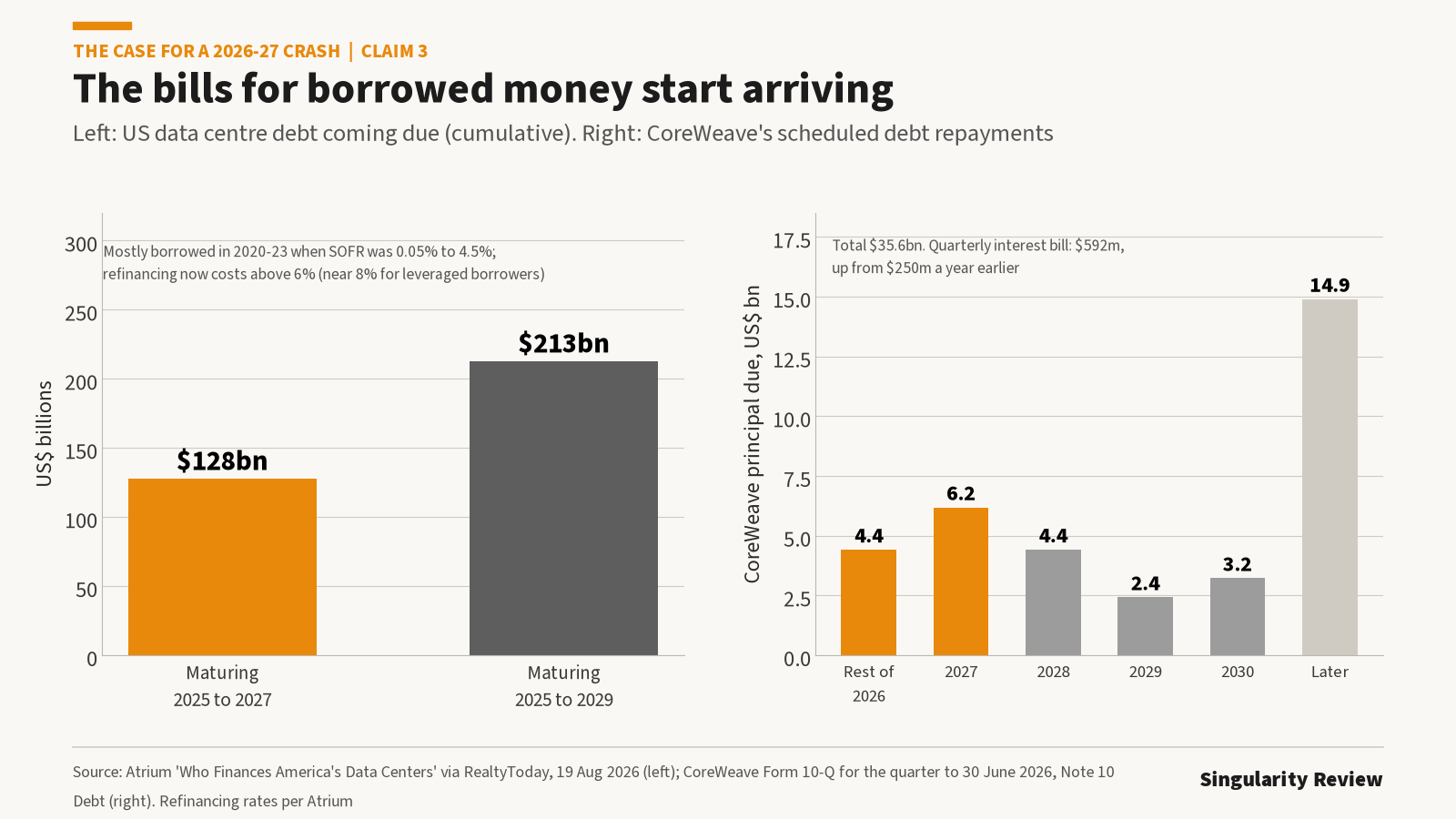 A "maturity wall" is the point where loans fall due and must be repaid or replaced at today's rates.
4. Profits may be flattered by slow write-offs. Companies spread the cost of a server over its expected life, a charge called depreciation. Many of the giants assume five or six years. Michael Burry, the investor famous for betting against the 2008 housing bubble, argues AI chips last two to three years and estimates that hyperscalers will understate depreciation by $176 billion between 2026 and 2028. A rough check by Yield Theory puts the gap at about $132 billion on a four-year life and $263 billion on a three-year life. The charges are already climbing: Meta's rose 40% in its latest quarter.
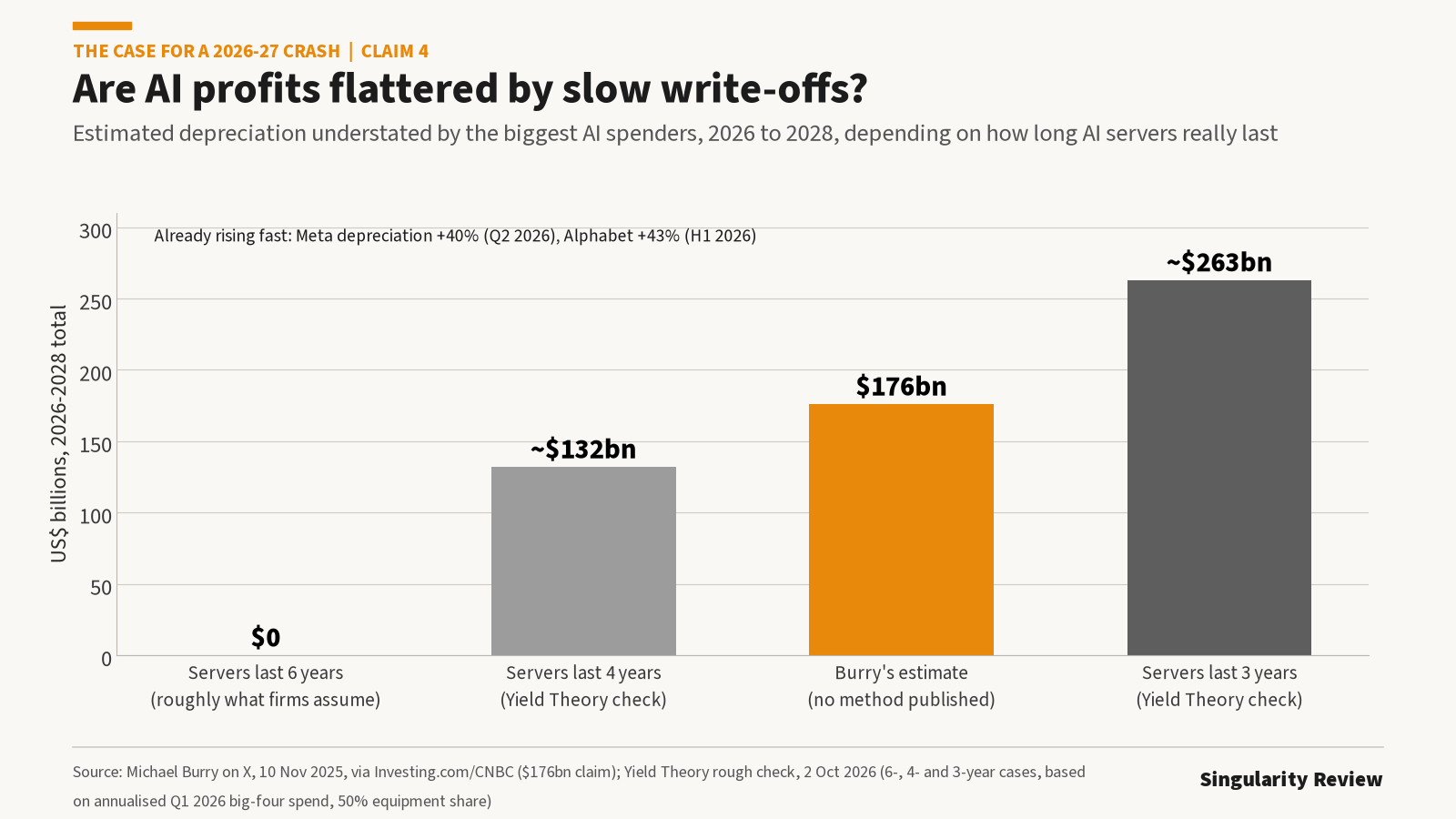 If the shorter lives prove right, reported profits fall even if no customer leaves.
5. Valuations leave little room, and money is getting dearer. The cyclically adjusted price-to-earnings ratio, or CAPE, compares prices with ten years of average inflation-adjusted profits. It stood at 41.67 on 5 October, close to the record 44.19 of December 1999. Meanwhile the 10-year Treasury yield hit 5.305% on 8 October, near a 24-year high. Dalio's mechanism is exactly this: rising rates, and "the point at which the bubble begins to burst."
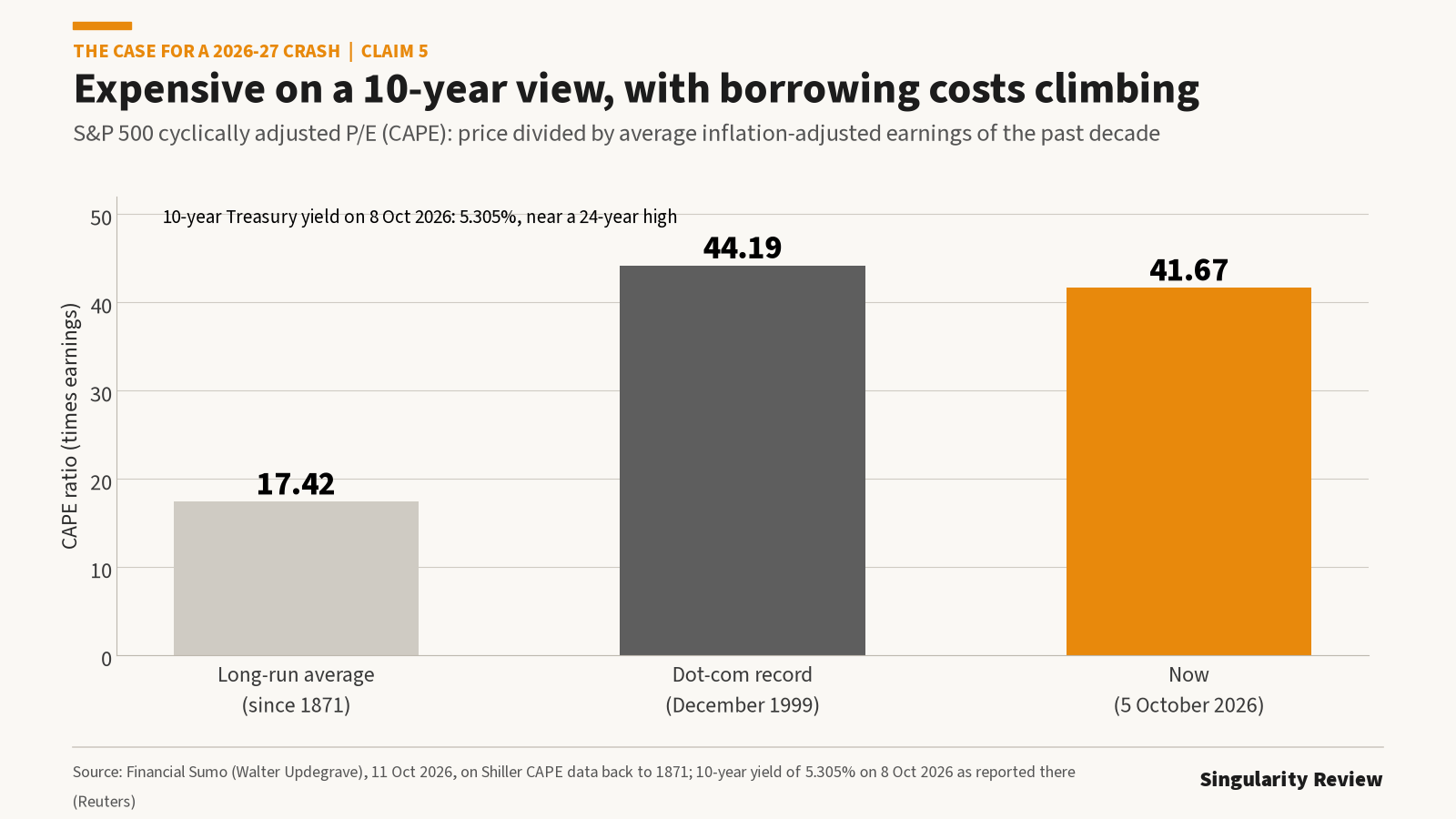 CAPE says little about timing. It says a lot about how far prices could fall.
The case against
1. Prices still rest on profits. The forward price-to-earnings ratio compares a share price with the profit analysts expect over the next year. For the S&P 500 it was 19.0 at the start of October, according to FactSet, below its five-year average of 19.8 and far below the 26.7 of 2000. FactSet expects third-quarter earnings growth of 29.5%. Nvidia trades at roughly 14 to 23 times expected earnings, depending on which year's forecast you use. Cisco, the bellwether of 2000, traded at about 132.
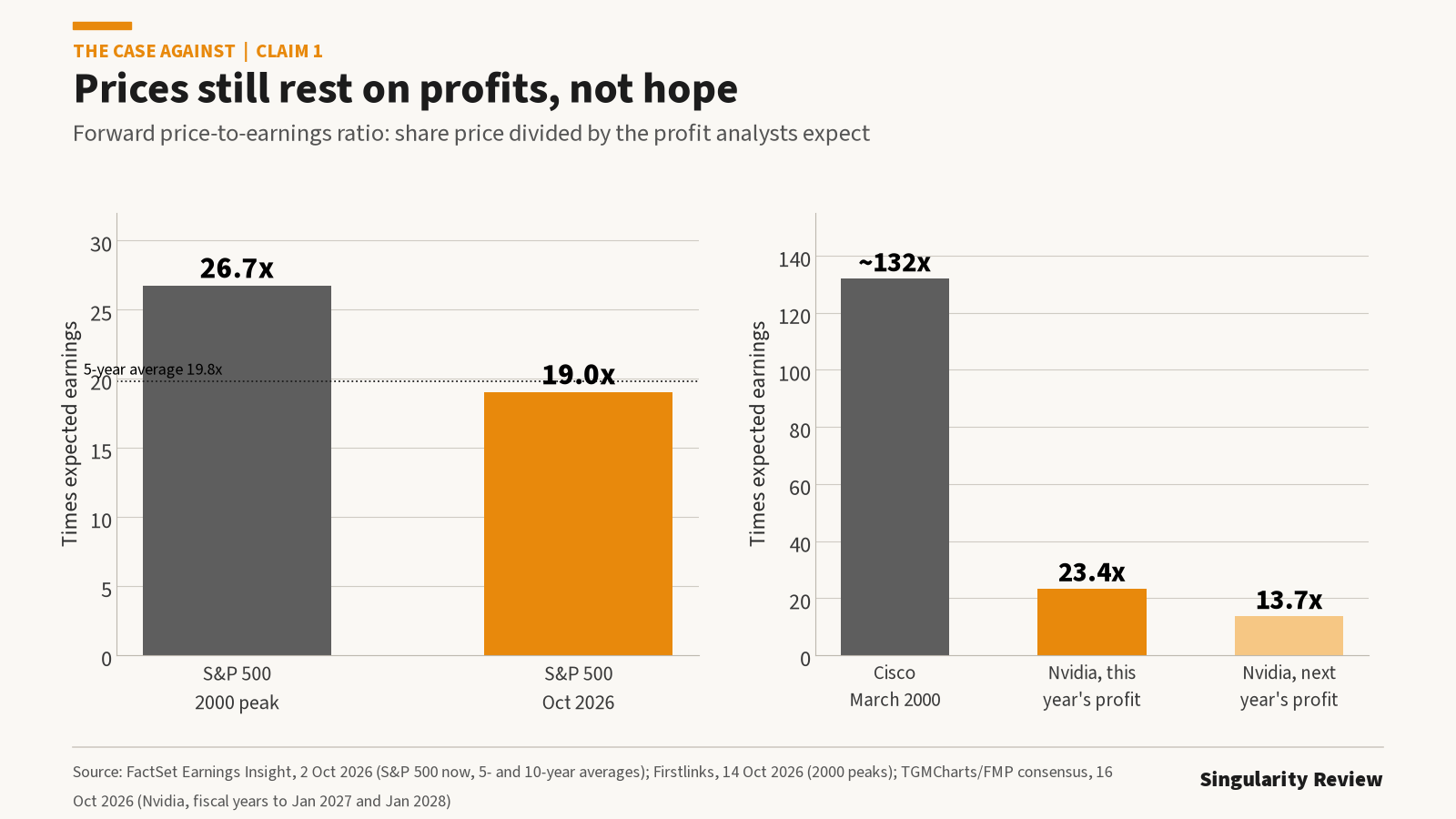 In a mania, prices outrun profits. Here, profits have largely kept up.
2. Demand is real, growing and signed. Google Cloud revenue grew 82% in the June quarter, Microsoft's Azure 43% and Amazon Web Services 37%. Microsoft reports $678 billion of contracted future revenue, up 84%; Oracle reports $664 billion and AWS $496 billion. Both Amazon and Microsoft say demand still exceeds the capacity they can supply. In 1999, much of the fibre being laid had no paying customer at the end of it.
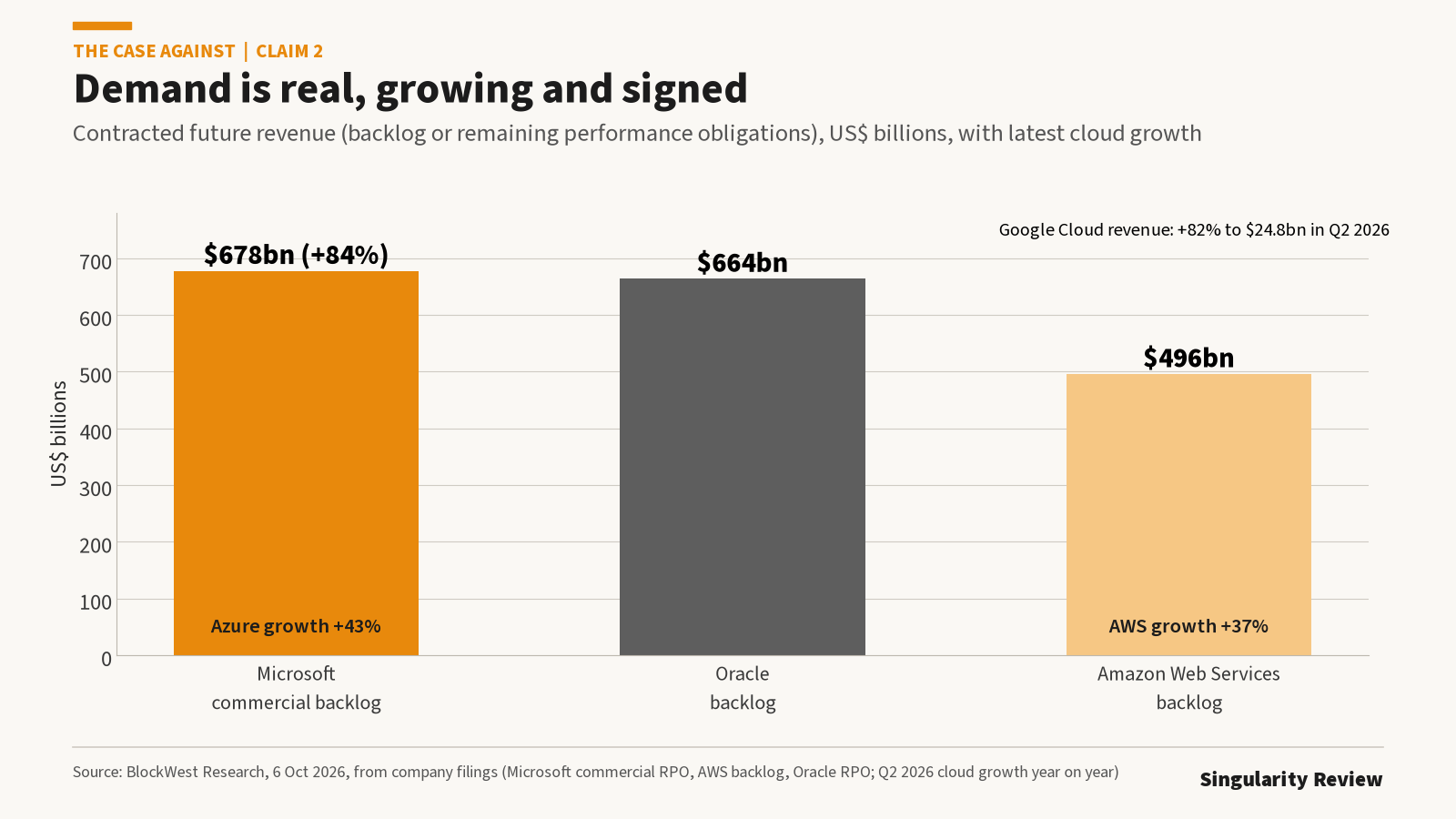 Backlog, or "remaining performance obligations," is revenue customers have already committed to pay.
3. The giants can afford their bets. The same four companies generated $171.8 billion of operating cash in a single quarter. Microsoft funded its spending entirely from cash and issued no net debt. Meta holds $90.3 billion of cash against $83.7 billion of long-term debt. CoreWeave's entire 2027 repayment would be a rounding error for any of them. The fragile borrowers are real, but they sit at the edge of the system, not at its core.
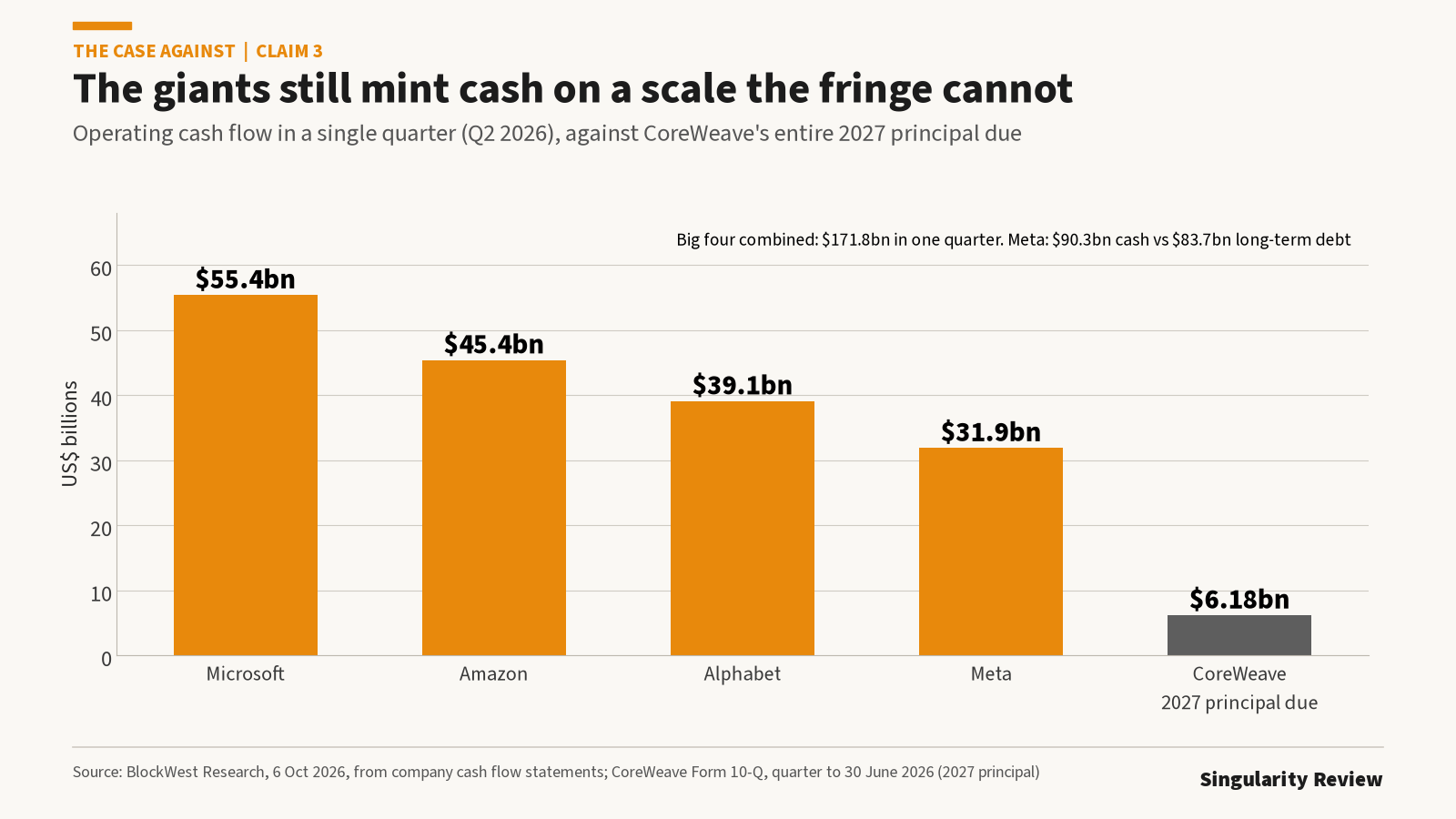 One quarter of cash flow at the big four is about 28 times CoreWeave's 2027 repayment.
4. The speculative fringe of 1999 is missing. In 1999, 476 companies listed on US exchanges, nearly 80% of them in technology. In 2026, fewer than 100 have listed so far. Bubbles usually end with a flood of weak companies selling shares to eager buyers. That flood has not arrived, although the planned listings of Anthropic and OpenAI could test the appetite.
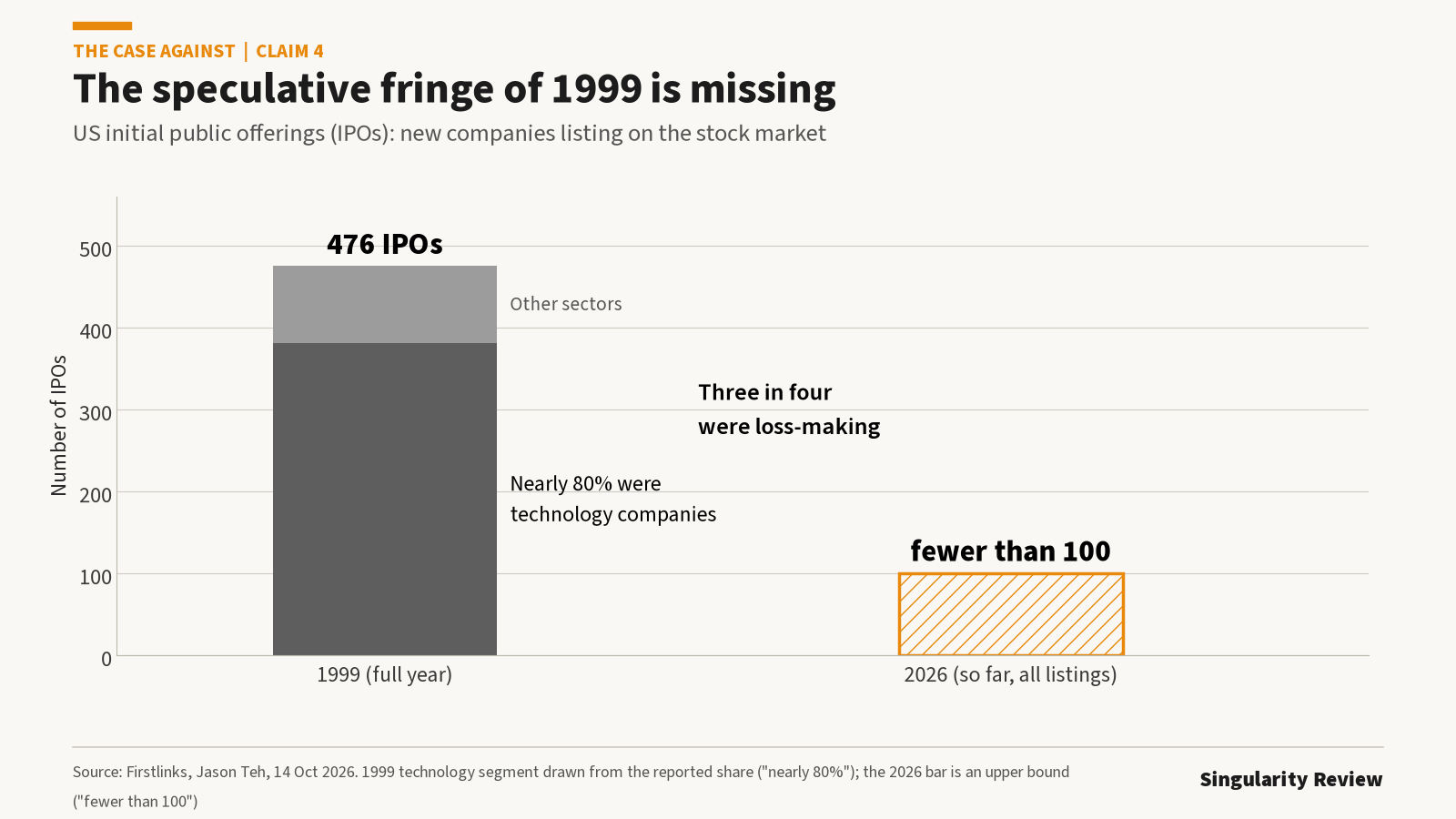 If the fringe arrives, it may arrive as two very large listings rather than hundreds of small ones.
5. A crash needs a trigger that has not yet appeared. By convention a 10% fall is a "correction" and a 20% fall a "bear market." This week's chip slide was a correction in one sector; the broad market barely moved. Even Klement says he would only go "full defensive" if the S&P 500 fell below its 200-day moving average. The other seven strategists Bloomberg tracks expect an average gain of 14%.
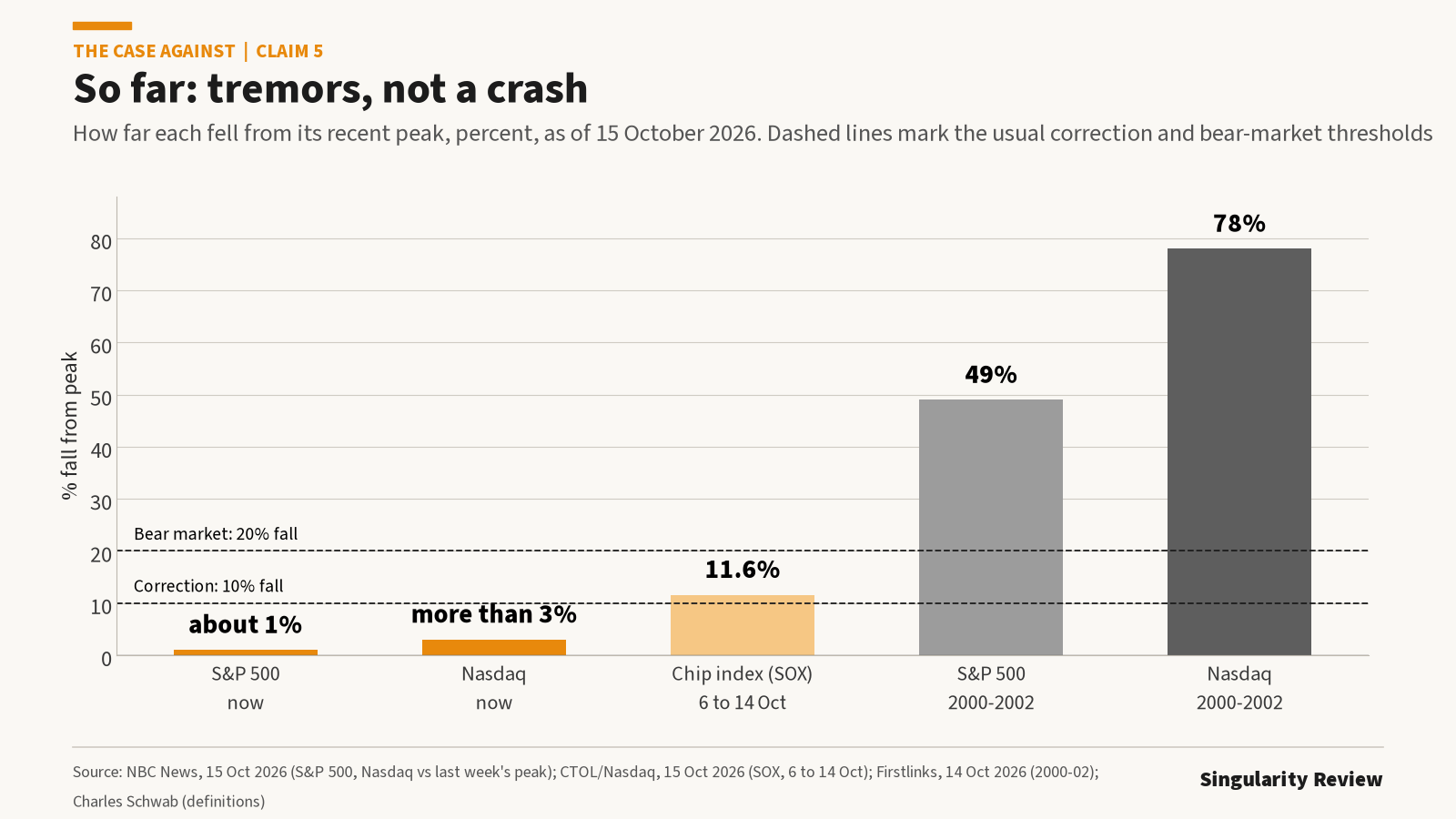 A tremor is not an earthquake, though earthquakes often start with one.
The long run: what AI is already doing
Bubble debates tend to be about prices. The more important question is whether the thing underneath is real. Railways and the internet both had crashes, and both went on to reshape the economy. So it is worth looking at evidence that has nothing to do with share prices.
Businesses are adopting it, steadily. The US Census Bureau asks a large sample of American firms every two weeks whether they used AI to produce goods or services. In late November 2025, 17.3% said yes. By early October 2026 the figure was 23.8%, after eleven rises in a row and one flat reading, and firms expect about 27.6% within six months. Large companies lead: in May, 37% of firms with 250 or more employees were users. These are modest numbers, which is the point: most of the economy has not started yet, so there is a long runway.
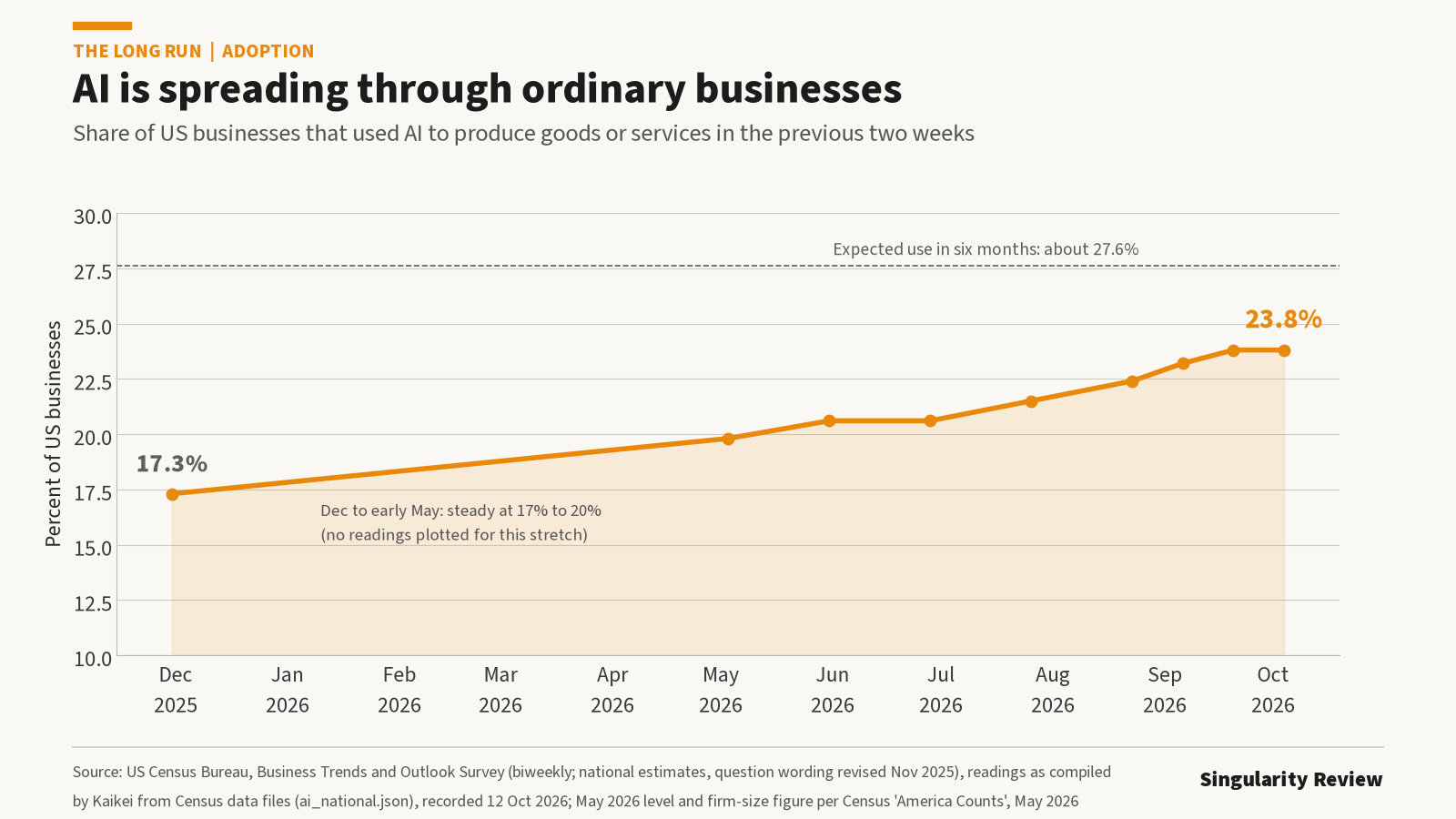 Census figures count firms of every size, including corner shops, so they look low next to surveys of big companies.
Among large organisations, use is close to universal but still shallow. In McKinsey's 2025 global survey, 88% of respondents said their organisation used AI in at least one business function, up from 78% a year earlier. Only about a third said they had started to scale it across the company. That gap between trying and embedding is where much of the future value lies.
People are paying for it. ChatGPT now reaches more than 1.2 billion people a week, OpenAI said at its developer conference in late September, and 2.5 million businesses use its products. Microsoft says it has 20 million paid seats for Microsoft 365 Copilot, its office assistant, and that Accenture alone signed up for more than 740,000. Anthropic, the maker of Claude, told investors its revenue rose from $4.7 billion in the first quarter of 2026 to $11.6 billion in the second and $16.8 billion in the third, and that it was profitable on an adjusted basis (a measure that leaves out some costs), CNBC reported. OpenAI's annualised revenue (a projection of yearly sales from a recent month) was about $50 billion at the end of September, according to Bloomberg. These are private companies, and their figures are not audited, but few if any technology companies have ever grown sales this fast at this size.
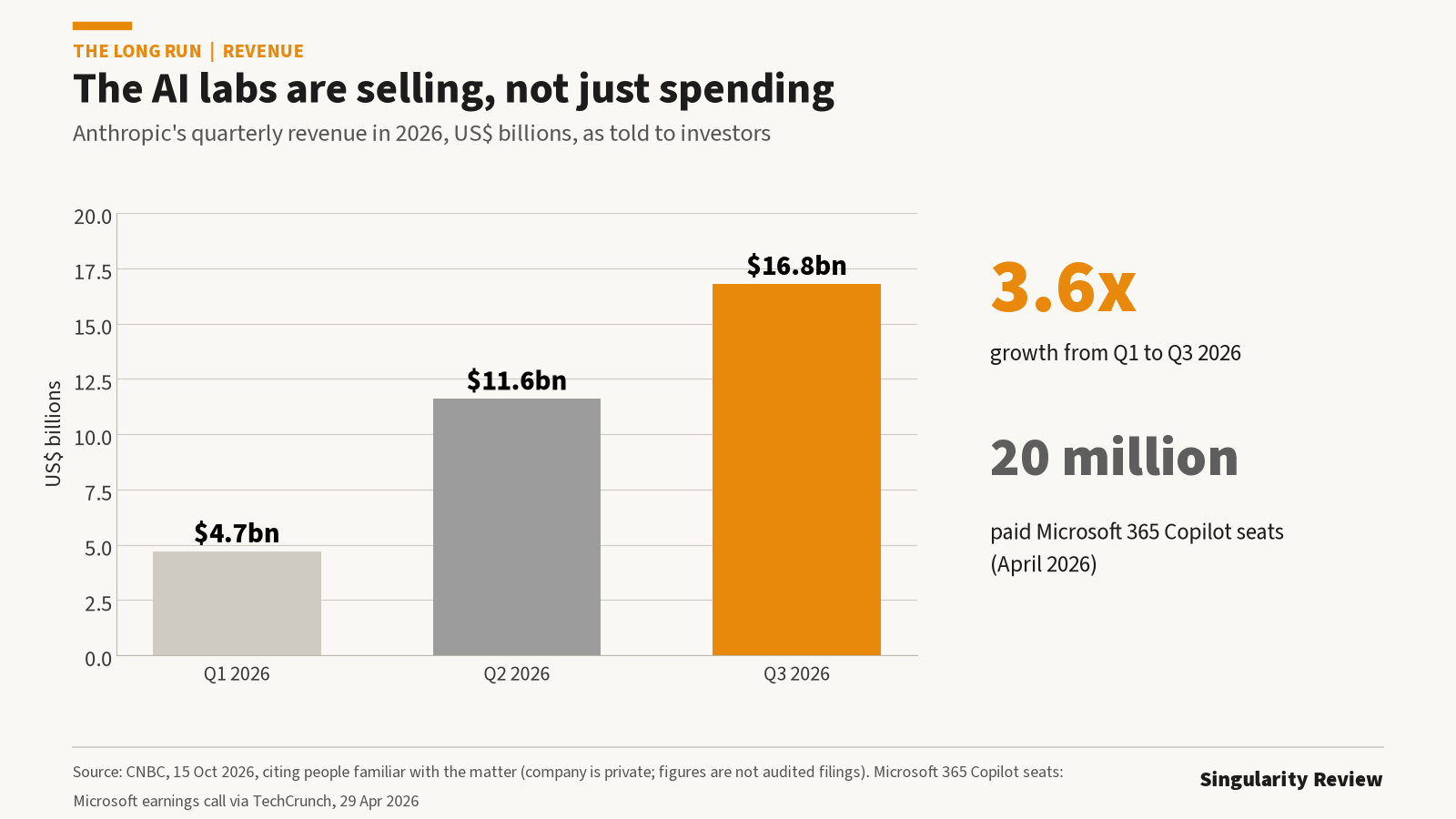 Fast revenue growth does not guarantee profits, but it is the opposite of a product nobody wants.
It makes workers more productive, unevenly. The best-known field study, by Erik Brynjolfsson, Danielle Li and Lindsey Raymond and published in the Quarterly Journal of Economics, followed 5,172 customer-support agents. Those given an AI assistant resolved 15% more issues per hour on average, with the biggest gains for newer, less experienced staff. A national survey by economists at the St. Louis Fed found that workers who used generative AI saved 5.4% of their working hours, about 2.2 hours in a 40-hour week, which they estimated could add about 1.1% to US productivity. The evidence is not all one-way. In a 2025 experiment by the research group METR, experienced open-source programmers working on their own projects took 19% longer with early-2025 AI tools, even though they believed the tools had sped them up. The lesson is that gains depend on the task and on learning to use the tools well.
Coding and science are where it bites first. In Stack Overflow's 2025 survey of more than 49,000 developers, 84% said they were using or planning to use AI tools, up from 76% a year earlier. In science, the AlphaFold database of predicted protein shapes, built by Google DeepMind and the European Bioinformatics Institute, has been used by more than 3 million researchers in over 190 countries. Its creators shared the 2024 Nobel Prize in Chemistry. Working out a single protein's structure in the laboratory could take years.
Capabilities keep rising. METR measures how long a software task (timed by how long it takes a skilled human) an AI system can complete on its own about half the time. In its January 2026 update, that length had doubled roughly every seven months since 2019, and faster since 2024, roughly every three months. The best model it measured in that update could handle tasks that take a person a little over five hours. METR stresses that these estimates are rough and that its tests are running out of headroom.
Do the "scaling laws" still hold? These are the observed patterns in which models get better as they are trained with more computing power and data. Many people who build these systems believe the curve has further to run. So far there is no hard wall in sight, and new ways of scaling keep appearing: after gains from simply making models bigger seemed to slow, labs found large improvements by letting models "think" longer before answering and by training them with trial-and-error feedback (reinforcement learning). The counterview deserves a hearing. Ilya Sutskever, a co-founder of OpenAI, said in late 2025 that the industry was moving "from the age of scaling to the age of research," because useful data is finite and simply adding size no longer transforms results. Electricity is another limit: the International Energy Agency expects data centres' power use to more than double to about 945 terawatt-hours by 2030, slightly more than Japan uses today. These constraints could slow progress. None so far has stopped it.
What would trigger it, and when
The next ten weeks are crowded. Meta reports on 21 October, and Microsoft and Alphabet on 28 October, with Amazon expected on 29 October. The Federal Reserve meets on 27 and 28 October and again on 8 and 9 December, when traders put the chance of another rate rise at about 67%. Nvidia is expected to report on 17 November, and Oracle and Broadcom on 9 December. Watch capex guidance most of all: those four giants need to spend about $440 billion in the second half of 2026 to hit their own targets.
Then come the listings. Bloomberg reports that Anthropic is aiming to start trading before Thanksgiving on 26 November, at a valuation of $1.8 trillion to $2 trillion. OpenAI's finance chief says it "will be a public company in 2027." In 2027 the debt clock matters more: CoreWeave's $6.2 billion falls due, as does the last of Atrium's $128 billion wave. Niles points to early 2027. Klement says he is warning about something that "might happen in six to nine months."
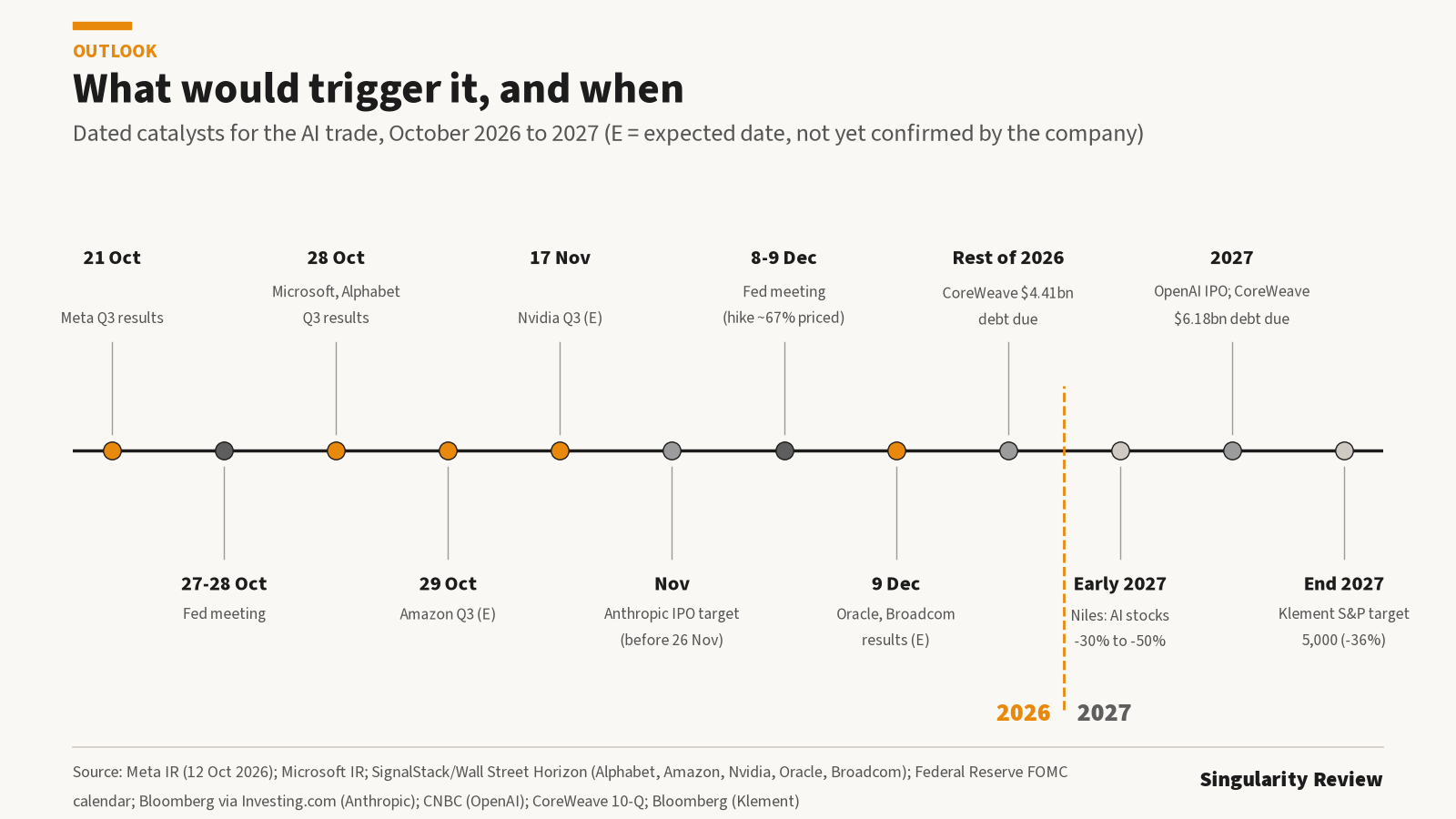 Dates marked "expected" have not yet been confirmed by the companies.
Our view
I think the forecasters are right about the fragility and too confident about the date, and that they underweight what is happening outside the stock market.
A sharp fall in AI stocks before the end of 2027 is, in my judgement, a real possibility. The pieces that most resemble 2000 are the debt-funded builders, the circular deals the IMF counted (14 of them, tied to $1.4 trillion of promised revenue), and the assumption that today's chips will earn for six years. If rates keep rising while those loans fall due, the weakest borrowers will crack first, and markets this concentrated do not contain damage well. A correction of 10% to 20%, with days of genuine panic, would not surprise me.
A lasting crash, in which AI is exposed as a fad and prices stay crushed for a decade, looks much less likely to me. That would require the demand to disappear, and the evidence points the other way: business adoption is rising every few weeks, paid usage is growing at a pace never seen before, studies find real productivity gains, and the people building these systems are fairly confident that capabilities will keep improving. Even the 2000 crash, painful as it was, did not stop the internet from becoming the backbone of the economy. The companies that survived it became the most valuable in the world.
What would change my mind? Business adoption stalling or falling, hyperscalers cutting their capex guidance, backlogs shrinking, or rental prices for AI chips falling sharply. For now, Yield Theory reports that the typical H100 rental price is up 14% from a year ago, which is not what a glut looks like.
Conclusion
The coming crash is the most predicted event in markets right now, and that alone should make us careful. Bubbles rarely burst on the timetable their critics set. The AI boom has a sound core and a leveraged edge, and the edge is where 2027 could hurt. But the core is getting stronger, not weaker. My view is that patient, long-term investors do not need to panic over a correction, however loud it gets. AI is going to change how we work, learn and do science, largely for the better, and over time markets tend to reflect what an economy actually produces. Watch the debt in the short run. Watch adoption in the long run.
This is the editor's opinion, not investment advice.