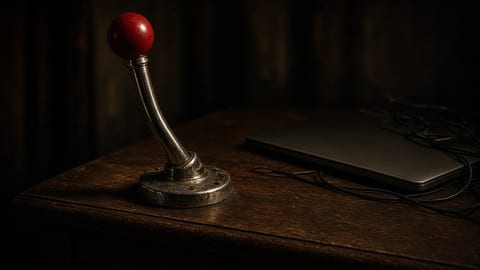
"Agentic coding is like a slot machine," the veteran engineer Steve Yegge wrote in June 2025. Each request, he said, is "a pull of the lever." Good results bring dopamine, he said, bad ones adrenaline, and together they create "the core addictive pull."
He was talking about vibe coding. Andrej Karpathy coined the term in February 2025 for building software by describing what we want in plain words and letting an AI write it, until we "forget that the code even exists." Tools like Cursor, Claude Code, Codex, Replit and Lovable made it routine. Since then, a lot of the people using them have reached for the same comparison.
It is worth taking seriously, and worth being clear about. This is a comparison drawn by users and by gambling science. Nobody has measured it for coding.
How a slot machine hooks the brain
Brain research gives three reasons slot machines are so hard to leave.
First, unpredictable rewards. Work by Wolfram Schultz and colleagues on monkeys showed that dopamine cells track the gap between the reward expected and the reward received, so surprise is what moves them. A 2003 study from his lab found a second dopamine signal that grew with uncertainty, strongest when the reward was a coin flip.
Second, near misses. In a 2009 brain scan study, Luke Clark and colleagues found that slot machine near misses felt worse than clear losses but made people want to play more, as long as they had set up the gamble themselves. Near misses also lit up brain areas that respond to real wins.
Third, speed. In a 2023 paper, Clark and Martin Zack argued that unpredictable rewards, repeated fast and often, can give gambling, games and social media a "drug-like" pull.
The unpredictable win
Every prompt is a gamble in that sense. An agent might build the whole feature in one go, or break something that worked. Armin Ronacher, the creator of Flask, wrote in January 2026: "The dopamine hit from working with these agents is so very real." Quentin Rousseau, writing at 2:47am in March, put it in three beats: "One more prompt. One more agent run. One more hit."
The near miss
The near miss may be the closest match. Vibe coding rarely fails outright. It almost works. Yegge described vibe coders at a conference being led off stage still saying "It'll work on the next try!" Jack Cohen, a coach, logged his own night: "10:57pm: hmm, it's not quite working," then on to midnight. One Hacker News user, quoted in a July thread, stayed up until nearly 2am "because I was so close to getting a plan right." And the prompt is ours, which gives exactly the sense of personal control that made near misses powerful in Clark's study.
One more pull, all night
Then there is speed. Results come in minutes, so the next pull is always close. Abhishek Ray, who teaches Claude Code workshops, logged 2,835 sessions in ten weeks and kept missing sleep: "I wanted to see the output. One more prompt. One more check." Yegge needed a nightly escape plan to get his laptop shut by 2am. Now agents can run on their own, so the machine never stops. Ray started agents before taking his son to the park, and one X user wrote in September of going to sleep while "15+ Claude code sessions keep running."
Money in the machine
Slot machines take coins. Coding agents take tokens. One young developer wrote in May that he ran up a $14,502 Claude Code bill in 31 days, with failed fixes being retried the biggest single cost: each retry, in effect, another pull. That is one self-reported case, in a post promoting his own cost tool. Ronacher admits to two months of "wasting tokens."
Where the comparison breaks
A slot machine produces nothing. A coding agent often produces working software. A 60-year-old developer on Hacker News wrote in March that Claude Code had re-ignited a passion: "I love it." Kenneth Reitz, the creator of the Requests library, argues the new loop can be real flow: "A conductor can enter flow as completely as a violinist." For many people this is simply good work that is hard to stop.
What we know
Research on vibe coding specifically is still missing. The closest is an August 2026 preprint surveying 119 software practitioners about AI chatbots at work: more than half often spent more time with the tools than intended, yet their written answers "rarely indicated loss of control." A 2024 study in Taiwan showed that problem use of ChatGPT can be measured, and it rose with usage time.
Our survey
So is vibe coding a slot machine, or just a very good tool? Stories cannot settle it. Singularity Review is launching a short survey of vibe coders: how late we work, how many agents we run, what we spend, and whether it feels like flow or something harder to stop. It is coming soon. Follow us to take part.